


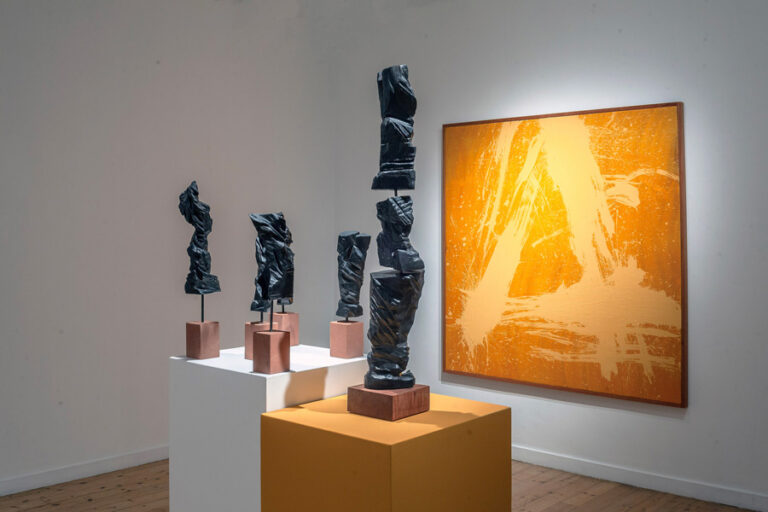

From mountain rocks ground into pigment to fallen timber transformed into sculpture, the artist is blurring the boundaries between the human body, landscape and the creative process.
What if a painting could do more than capture a landscape? What if it could actually contain a piece of it? For artist Jonathan Freemantle, nature is not simply something to admire from afar. It is the very material from which his art takes shape.
Spotlighted by Gallery MOMO, Jonathan’s distinctive practice brings together art, landscape and raw materials, using mountain rocks, fallen timber, natural indigo and ochre to create works that carry the physical essence of the places that inspire them.
Born in Cape Town in 1978 and now based in Edinburgh, Jonathan approaches painting and sculpture as a way of dissolving the boundaries between the human body and the natural world. Rather than merely depicting a mountain, forest or field, he incorporates materials gathered from these environments into his work, grinding rocks by hand to create pigments from the very landscapes he seeks to explore.
The result is an intimate relationship between place and artwork, where the landscape is not just the inspiration but an integral part of the finished piece.
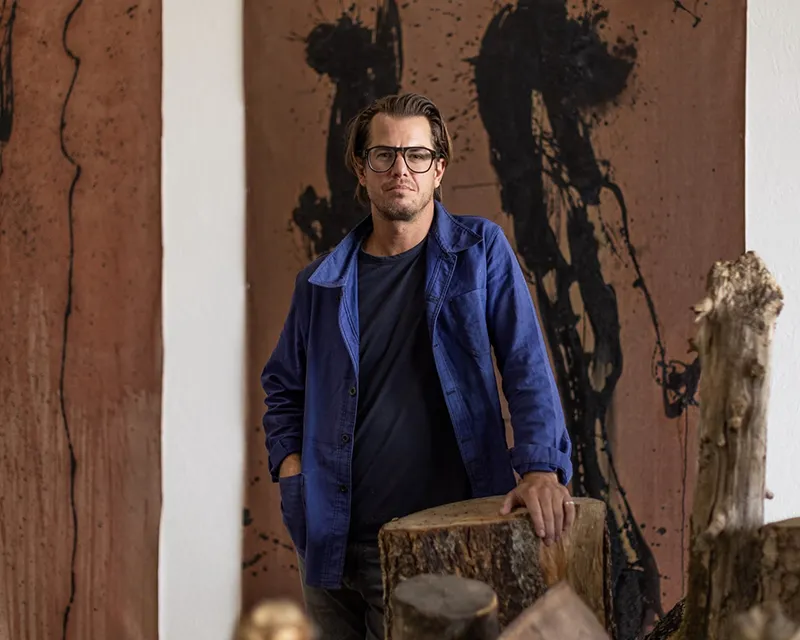
A Practice Rooted in Nature
Jonathan’s artistic journey began early. At just 17, he was selected as one of five students worldwide for a five-year apprenticeship at St Oswald’s Academy in London, where he trained in traditional drawing, painting, sculpture and geometry. This rigorous foundation continues to inform his approach, which balances technical discipline with an immersive, almost elemental relationship with his materials.
Since 2007, his work has been exhibited internationally, with solo presentations in London, Cape Town, Amsterdam, Madrid, Barcelona, Johannesburg and Edinburgh. His commissions include a major project for Johannesburg’s Standard Bank Gallery.
“My work explores the relationship between my body, time and the earth, each of which serve as materials and as inspiration,” Jonathan explains. His practice positions the body as an organic presence within the landscape, bringing nature directly into the physical act of making art.
From the Studio to International Collections
Jonathan’s relationship with Gallery MOMO includes the solo exhibitions The Fallen Tree (2024) and Spirit Matter(2022). His work also features in Totemic at Messums Gallery in London and Exploded View, presented with the Nirox Foundation and BlackBrick in Cape Town during 2026.
This year brought a particularly significant milestone: all six works from his 2022 exhibition A Mountain is Harder to Climb Than You Think were acquired by Muzeum Sztuki in Łódź, Poland, and now form part of the museum’s permanent collection. They join works by influential artists including Fernand Léger, Max Ernst, Hans Arp, Joseph Beuys, Lawrence Weiner and Christian Boltanski.
His work has also attracted the attention of celebrated French chef Yannick Alléno, who acquired pieces for his new restaurant, Pavyllon Lyon, in France.
Other public and private collections holding Jonathan’s work include the Demarco Foundation Archive, the Nirox Foundation and the private collection of HM King Charles III.
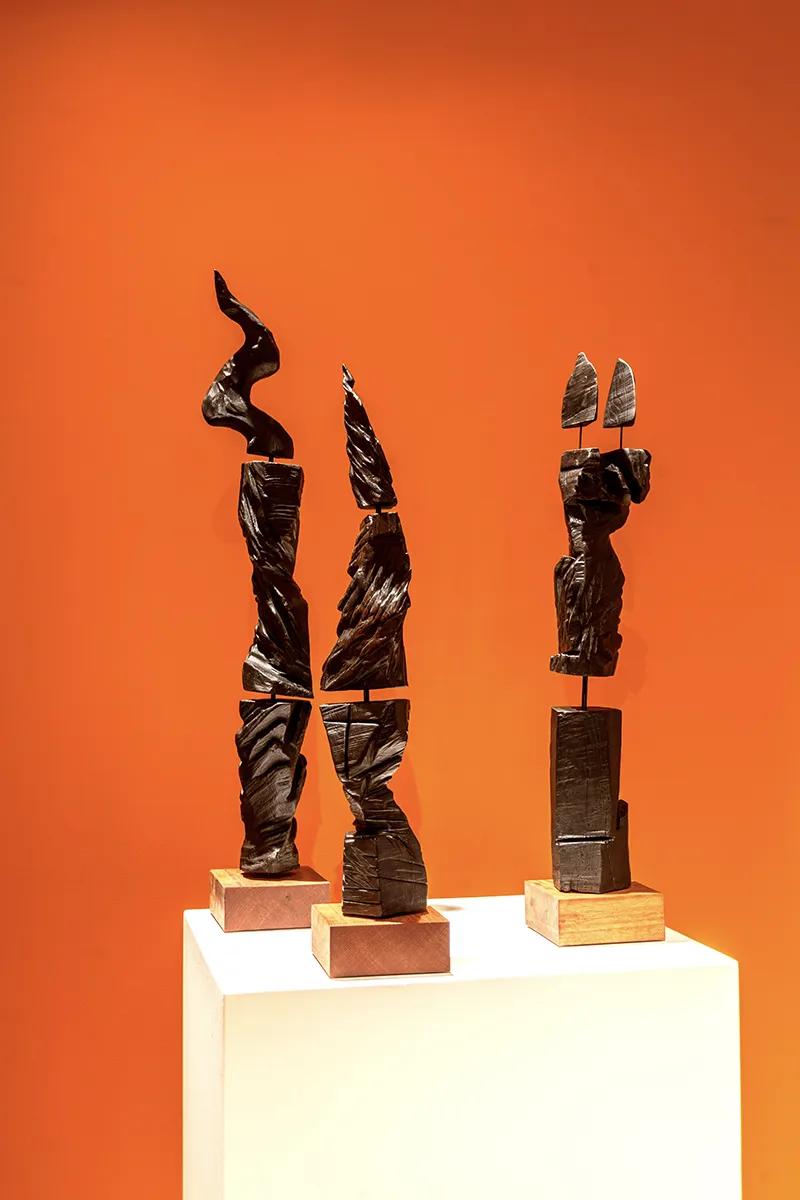
Beyond the Canvas
Jonathan’s creative interests extend beyond his own studio practice. In 2002, he established the painting department at The Art Academy in London and published Anatomy Made Simple for Artists in 2004. He later co-founded the Edinburgh International Fashion Festival in 2012 and co-directed Johannesburg’s Hazard Gallery from 2015 to 2019.
Since returning to Edinburgh in 2019, he has focused on his full-time studio practice, continuing to explore the relationship between the earth, the body and the passage of time.
For Jonathan, spending time in forests and on mountain peaks is as much a part of the creative process as working with paint and canvas. He gathers rocks, transforms them into powder and uses the resulting pigments to paint the very environments from which they came.
It is an approach that encourages us to look at landscape differently, not as a distant scene framed by a window, but as something we are physically and intrinsically connected to.
Through its spotlight on Jonathan Freemantle, Gallery MOMO celebrates an artist whose work invites a deeper conversation about our relationship with the natural world, and what happens when art becomes an extension of the earth itself.